Technology
Technology
A modular platform, three core software modules and a strict safety architecture, shared across every mission.
Onboard architecture
Payload
Interchangeable
- Thermal LWIR 640 × 512: available
- LiDAR, multispectral, gas: coming
Onboard computer
Jetson Orin Nano
- HorusVision
Flight controller
Pixhawk 6C
- ArduPilot
- HorusMav
Link
MAVLink
- SiK radio
Ground station
HorusGCS
- Planning and live tracking
HorusMav — Autonomous flight control
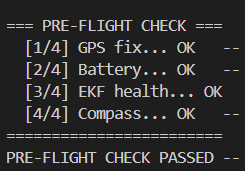
HorusMav is the MAVLink control layer of HORUS I. It interfaces with ArduPilot through pymavlink, orchestrates a fixed-heading lawnmower mission, monitors vehicle health continuously and executes the onboard failsafes.
- MAVLink / ArduPilot interface (pymavlink)
- Lawnmower mission with fixed heading
- Automatic link, battery and flight-mode monitoring
- Lidar-guided landing
- Full pre-flight check (GPS, EKF, compass)
- Onboard telemetry logger (black box)
HorusVision — AI anomaly detection
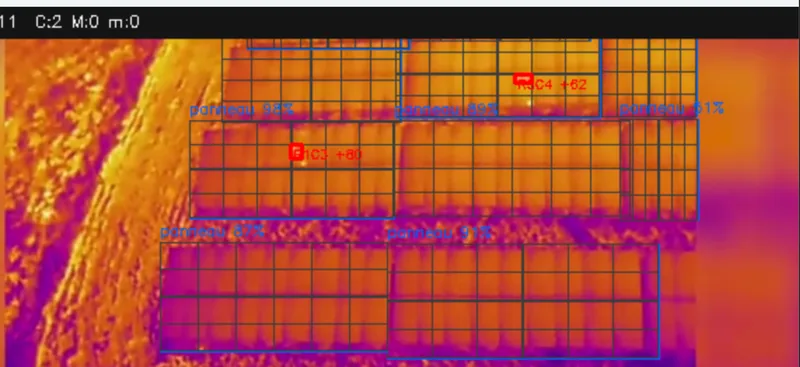
HorusVision analyzes payload imagery in real time. With the thermal camera, the first payload available, the YOLO model detects and delineates each solar panel, while a relative-gradient algorithm flags abnormal cells and pinpoints them via GPS ray-casting.
- Panel detection via YOLO model (Roboflow)
- Hotspot analysis via relative gradient
- GPS localization of each defect (ray-casting)
- Multi-pass tracking with dynamic GSD
- Severity classification (minor, moderate, critical)
- Automatic post-mission PDF report
HorusGCS — Ground station, mission planning and real-time control
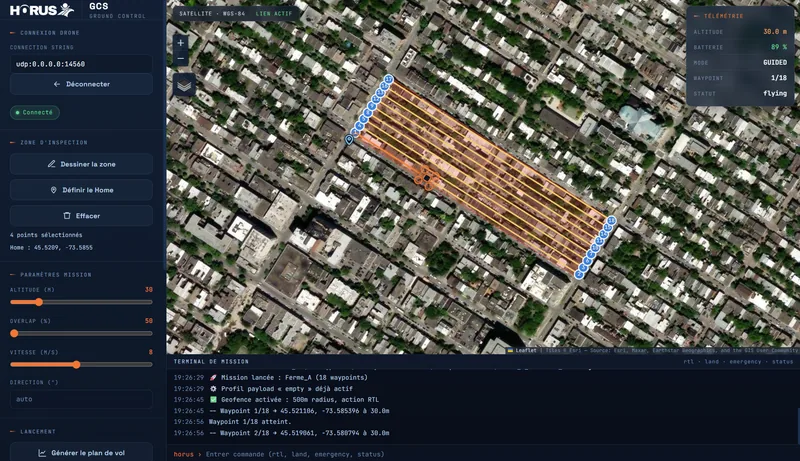
HorusGCS is the web interface that runs a mission end to end. The operator delineates the zone on the satellite map; the flight-grid calculator automatically sizes pass spacing, overlap and waypoints from the altitude and the onboard sensor. The generated plan feeds directly into HorusMav, then the mission is tracked live — drone position, telemetry and safety commands always within reach, without ever touching a terminal.
- Zone drawing on the satellite map
- Automatic flight-grid calculation (spacing, overlap, GSD)
- Plan generation with direct HorusMav integration
- Real-time drone position and telemetry
- Return-to-launch (RTL), land and emergency stop commands
- Reconnect to a mission in progress
5-level safety architecture
Radio transmitter
Immediate manual override: the operator can retake control at any time with the radio. Absolute priority over any software command.
Flight-mode monitoring
External intervention detection: if Mission Planner, QGroundControl or the radio switches the flight mode, the script halts immediately and stops sending conflicting MAVLink commands.
Automatic link monitoring
A dedicated thread watches MAVLink heartbeats. If none is received for 30 seconds, return-to-launch (RTL) is triggered automatically.
Battery monitoring
Energy failsafe: voltage and battery percentage are monitored continuously. Return threshold adjusted per active payload.
Onboard computer monitoring
Preventive return if the Jetson degrades (CPU, memory, temperature). The FS_GCS_ENABLE parameter triggers an autonomous return if the Jetson stops responding.
Automatic pre-flight check
| 3D GPS fix | ≥ 8 satellites — HDOP ≤ 2.0 |
|---|---|
| Battery | ≥ 30% to allow arming |
| EKF health | attitude, horizontal and vertical speed validated |
| Compass | present, enabled and calibrated |
| Wind | estimated speed ≤ 8 m/s (optimal inspection conditions) |