Thermal
Energy — phase 1, 2026.
Product
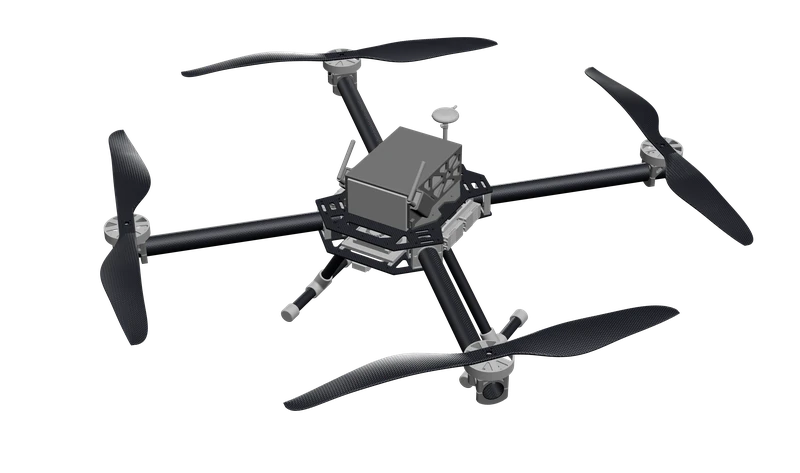
Modular autonomous quadcopter, engineered for critical industrial inspections.
| Empty weight | 6.5 kg |
|---|---|
| Max payload | 6.5 kg |
| Dimensions | 120 × 120 cm · 170 cm diagonal |
| Target endurance | 85 min |
| Flight controller | Pixhawk 6C (ArduPilot) |
| Onboard computer | NVIDIA Jetson Orin Nano |
| Available payload | Radiometric LWIR thermal camera |
| Thermal resolution | 640 × 512 px |
| GSD at 15 m | ≈ 1.96 cm/px |
| Navigation system | GPS + EKF ArduPilot + H-Flow |
| Telemetry | MAVLink / SiK Radio |
| Data | Data processed locally, no third-party cloud |
| Certification | TC Advanced RPAS — in progress |
| Assembly | Q4 2026 |
Performance from analytical simulation with real components · field validation planned for Q4 2026.
The HORUS I payload bay accepts multiple configurations: thermal sensors, LiDAR, multispectral cameras or gas sniffers. The software architecture abstracts the payload so new missions can be added without rewriting the flight stack.
Energy — phase 1, 2026.
Mining and construction — phase 2, 2027.
Agriculture — phase 2, 2027.
Oil & gas and environment — phase 3, 2028 and beyond.
First market targeted by the platform. Industrial solar farms impose inspection constraints that legacy methods can no longer absorb — and the same architecture already covers energy pipelines, then tomorrow HV lines and substations.